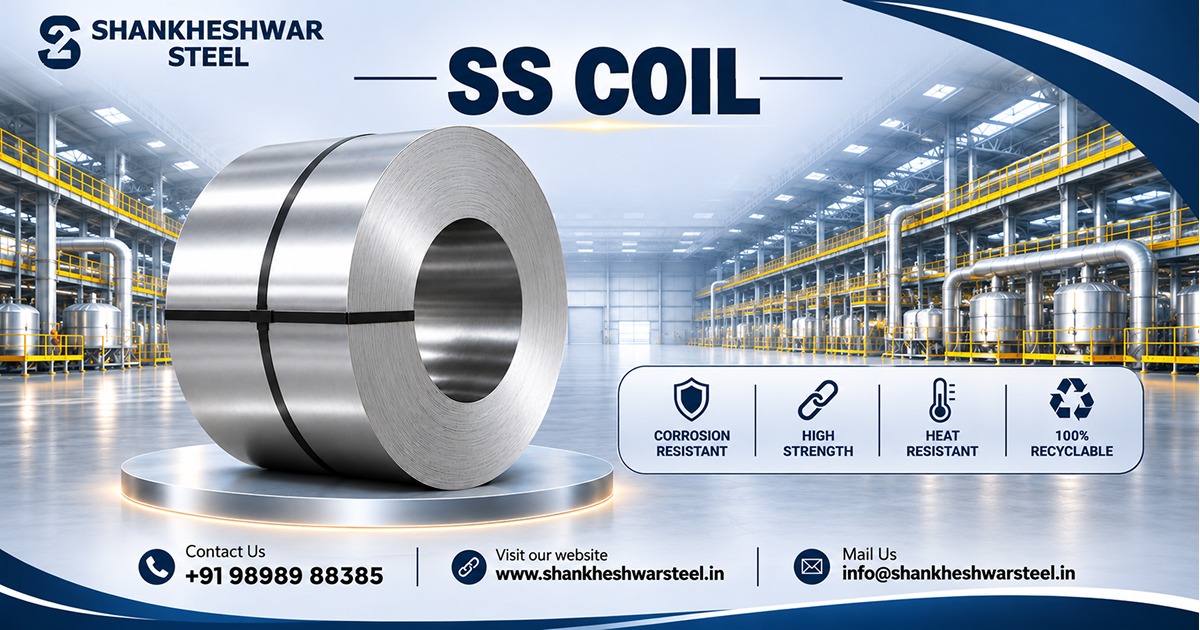
Selecting the correct stainless steel grade is essential for corrosion resistance, fabrication quality, and long-term performance. SS 304 and SS 316 Stainless Steel Coils for Industrial Applications help businesses meet varied material requirements with support from Shankheshwar Steel in Ahmedabad, Gujarat, India.
Understanding the Difference Between SS 304 and SS 316 Coils
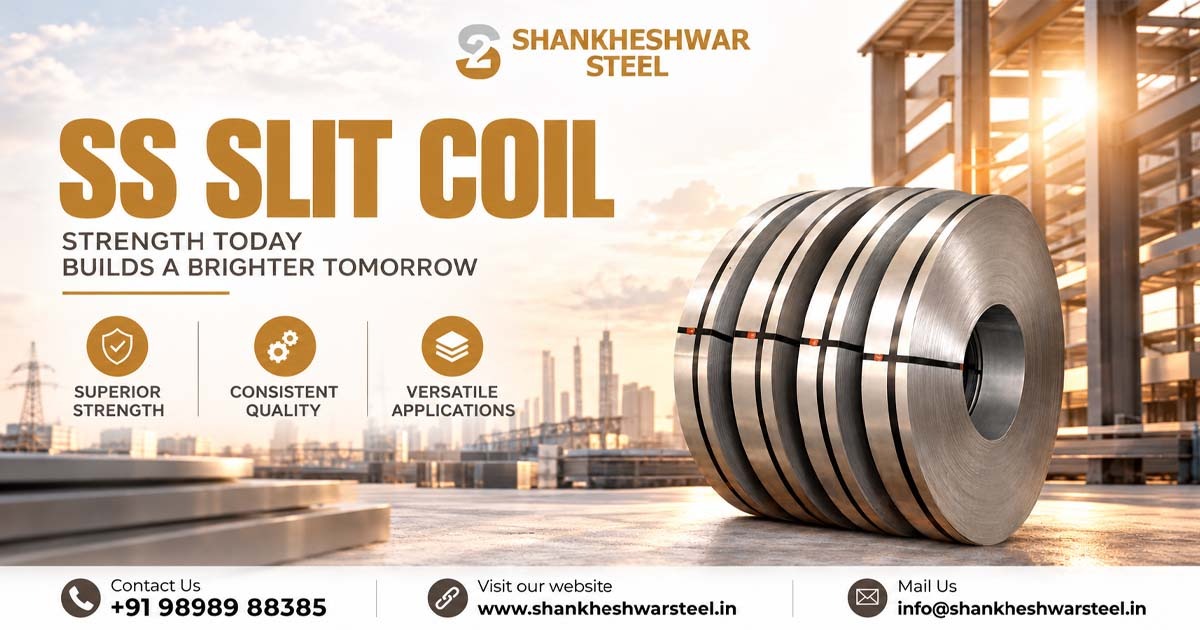
Stainless steel coils are continuous flat-rolled metal sheets supplied in coil form. They are widely used by manufacturers that require consistent material thickness, suitable surface finishes, and convenient processing for different industrial components.
SS 304 and SS 316 are two commonly selected austenitic stainless steel grades. Although they share several characteristics, their chemical compositions and corrosion resistance differ.
SS 304 Stainless Steel Coil
- Contains approximately 18% chromium and 8% nickel.
- Offers good resistance to corrosion in many general industrial environments.
- Provides good formability and weldability.
- Suitable for equipment exposed to moisture, food-related environments, and ordinary atmospheric conditions.
- Commonly selected for general fabrication and manufacturing requirements.
SS 316 Stainless Steel Coil
- Contains chromium, nickel, and approximately 2–3% molybdenum.
- Provides improved resistance to pitting and crevice corrosion, particularly in chloride-containing environments.
- Suitable for demanding chemical processing and marine-related conditions.
- Offers good fabrication and welding characteristics.
- Preferred where exposure conditions require additional corrosion resistance.
The right grade depends on the operating environment, chemical exposure, cleaning process, temperature, and expected service conditions.
How to Select the Correct Stainless Steel Grade for Your Project
Choosing between SS 304 and SS 316 requires more than comparing their purchase prices. Buyers should evaluate the complete application before finalising the material.
1. Check the Operating Environment
- Select SS 304 for many general-purpose industrial applications.
- Consider SS 316 where chloride exposure or more aggressive chemical conditions are expected.
- Review the cleaning chemicals and environmental conditions before ordering.
2. Confirm Coil Dimensions
Discuss the following requirements with your supplier:
- Thickness in millimetres.
- Coil width and required length.
- Inside and outside coil diameter.
- Coil weight and handling capacity.
- Dimensional tolerances.
3. Identify the Required Surface Finish
Different fabrication processes require different surface conditions.
- 2B finish for common industrial fabrication.
- BA finish for applications requiring a bright, smooth appearance.
- No. 4 finish for brushed or decorative surfaces.
- Other finishes according to the intended manufacturing process.
4. Consider Fabrication Requirements
Check whether the material will undergo cutting, bending, stamping, rolling, or welding. The selected thickness, grade, and temper should suit the planned fabrication method.
5. Evaluate Total Purchasing Cost
Compare the complete material requirement rather than selecting a grade only on its initial price.
Consider:
- Material availability.
- Required quantity.
- Processing and cutting costs.
- Material wastage.
- Transportation and handling.
- Expected service environment.
From Coil Supply to Finished Industrial Components
Stainless steel coils are generally processed according to the dimensions and requirements of the final product. Understanding this sequence helps purchasing and production teams coordinate material requirements.
Step 1: Grade and Material Identification
The required stainless steel grade is identified according to the application. Buyers should confirm whether SS 304 or SS 316 is suitable for the operating environment.
Step 2: Coil Inspection
Before processing, the material is checked for:
- Grade identification and documentation.
- Thickness and width.
- Surface condition.
- Visible scratches, dents, or handling damage.
- Coil condition and packaging.
Step 3: Slitting and Cutting
The coil can be processed into narrower strips or sheets according to the production requirement. Slitting and cut-to-length operations help prepare material for downstream manufacturing.
Step 4: Fabrication and Component Production
The processed stainless steel is used for manufacturing different industrial products through forming, bending, stamping, welding, or other suitable fabrication processes.
Proper material handling throughout these stages helps reduce surface damage and unnecessary production waste.
Quality Checks Buyers Should Complete Before Ordering
Material quality directly affects fabrication results and the suitability of finished components. Procurement teams should verify the following details before confirming a purchase.
| Quality checkpoint | What to verify |
| Grade identification | SS 304 or SS 316 |
| Chemical composition | Confirm through relevant material documentation |
| Thickness | Match the required tolerance |
| Coil width | Check against production drawings |
| Surface finish | Confirm the specified finish |
| Material condition | Check for visible damage and defects |
| Documentation | Request applicable material test certificates |
| Packaging | Ensure protection during storage and transportation |
Additional purchasing precautions:
- Do not accept grade identification based only on appearance.
- Verify material traceability where required.
- Confirm the supplied quantity and coil weight.
- Check whether the selected grade suits the actual chemical environment.
- Discuss storage and handling requirements to prevent contamination and surface damage.
Planning Material Requirements for Different Industrial Projects
Every manufacturing project has different material requirements. SS 304 and SS 316 Stainless Steel Coils for Industrial Applications should be selected according to the intended component, production method, and operating environment.
Important project considerations include:
- Chemical exposure: Identify the type and concentration of chemicals that may contact the material.
- Fabrication method: Consider the bending, forming, welding, and cutting operations.
- Thickness requirements: Match the material thickness with structural and manufacturing needs.
- Surface appearance: Select a finish according to functional and visual requirements.
- Production quantity: Estimate the required coil weight and processing dimensions.
- Storage conditions: Protect the material from moisture, contamination, and physical damage.
Services
Shankheshwar Steel can support buyers in coordinating stainless steel material requirements through relevant product-related assistance.
- Stainless Steel Grade Consultation: Assistance in understanding SS 304 and SS 316 material requirements for different industrial applications.
- Product Selection Assistance: Guidance on identifying suitable coil grades, dimensions, and surface finishes according to buyer requirements.
- Material Requirement Coordination: Support in discussing specifications, quantities, and procurement requirements for industrial projects.
- Technical and Order Assistance: Assistance with product-related queries, documentation requirements, and order coordination.
Stainless Steel Coil Requirements Across Gujarat
Manufacturing, engineering, chemical processing, infrastructure, fabrication, and equipment production businesses across Gujarat require suitable stainless steel materials for their operations. Shankheshwar Steel provides manufacturing support from Ahmedabad, Gujarat, India, for buyers exploring stainless steel coil requirements in Ahmedabad, Surat, Vadodara, Rajkot, Gandhinagar, Bharuch, Ankleshwar, Vapi, Valsad, Morbi, Jamnagar, Bhavnagar, Junagadh, Mehsana, Kalol, Sanand, Changodar, Vatva, Naroda, Halol, Dahej, and Savli.
Why Choose Shankheshwar Steel for Stainless Steel Coil Requirements?
Selecting a material supplier involves understanding product requirements, verifying specifications, and coordinating procurement according to project needs.
Shankheshwar Steel supports customers exploring stainless steel products for industrial and commercial requirements.
Customers can approach the company for:
- Requirement Understanding: Discussing the intended application and material grade requirements.
- Product Guidance: Evaluating suitable stainless steel options according to operating conditions.
- Procurement Coordination: Discussing dimensions, quantities, and material documentation.
- Customer Assistance: Addressing product-related and order-related queries.
With manufacturing support from Ahmedabad, Gujarat, India, Shankheshwar Steel works with customers looking for suitable stainless steel material solutions.
Visit the official website: https://shankheshwarsteel.in/
Frequently Asked Questions
Q1: What is the main difference between SS 304 and SS 316 stainless steel coils?
A: SS 304 is commonly used for general corrosion-resistant applications, while SS 316 contains molybdenum, providing improved resistance to pitting and crevice corrosion in many chloride-containing environments.
Q2: Which stainless steel coil is better for chemical processing?
A: SS 316 is often considered for chemical processing environments because of its improved corrosion resistance. However, the correct selection depends on the specific chemical, concentration, temperature, and exposure conditions.
Q3: What information should I provide when purchasing stainless steel coils?
A: Provide the required grade, thickness, width, surface finish, quantity, and application details. You should also discuss documentation, dimensional tolerances, and delivery requirements.
Conclusion
Choosing the right stainless steel grade helps manufacturers manage corrosion resistance, fabrication requirements, and material costs. SS 304 and SS 316 Stainless Steel Coils for Industrial Applications offer different solutions depending on operating conditions. Shankheshwar Steel supports industrial buyers with manufacturing support from Ahmedabad, Gujarat, India.
Looking for suitable SS 304 or SS 316 stainless steel coils for your industrial project? Contact Shankheshwar Steel to discuss your material grade, dimensions, quantity, and product requirements.
Website: https://shankheshwarsteel.in/contact-us/
Call Us: +91 98989 88385
Email Us: info@shankheshwarsteel.in
For more information, please feel free to contact us.