Industrial piping systems require reliable connections to maintain proper fluid flow, prevent leakage, and support safe operations. Choosing a suitable Stainless Steel Pipe Fittings Manufacturer & Supplier helps businesses source compatible fittings for different industrial requirements. Shankheshwar Steel supports buyers with manufacturing assistance from Ahmedabad, Gujarat, India.
Understanding the Role of Stainless Steel Pipe Fittings in Industrial Piping
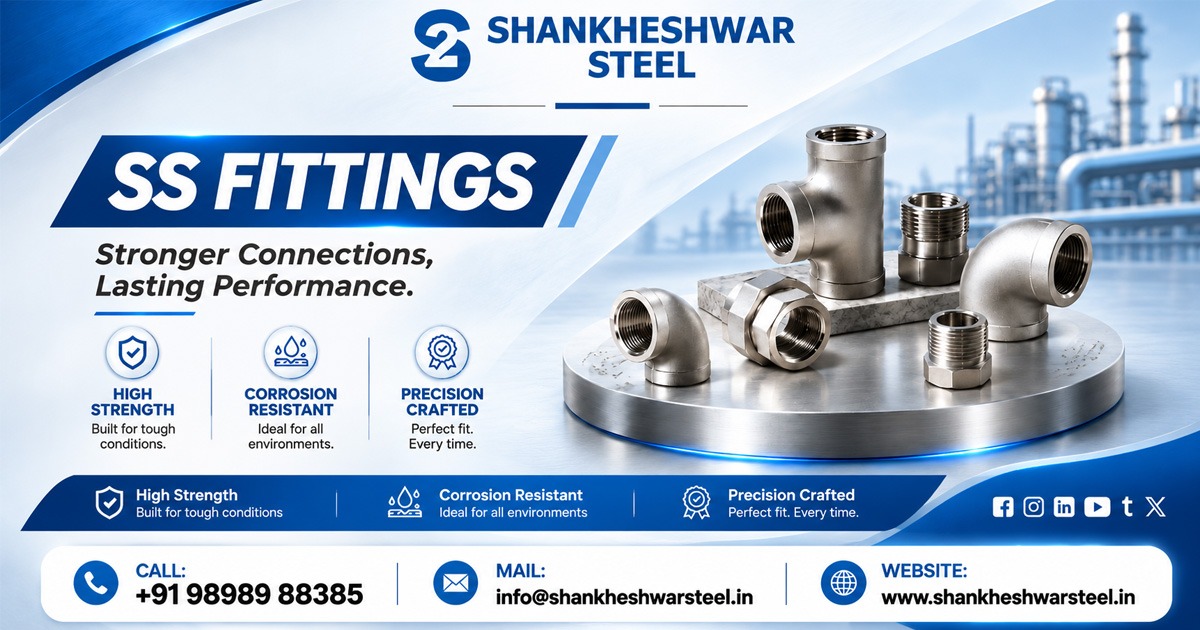
Stainless steel pipe fittings are connecting components used to join, redirect, branch, reduce, or control the flow of liquids and gases through piping networks. They help create functional pipeline layouts while maintaining suitable connections between different pipe sections.
In industrial environments, incorrect fitting selection can lead to leakage, pressure-related problems, corrosion, and difficulties during maintenance. Selecting fittings according to the operating conditions helps reduce these risks.
Common types of stainless steel pipe fittings include:
- Elbows: Change the direction of pipeline flow.
- Tees: Create branch connections within a piping network.
- Reducers: Connect pipes with different diameters.
- Couplings: Join two pipe sections.
- Unions: Allow pipe connections to be disconnected for maintenance.
- Caps and Plugs: Close unused pipeline ends.
- Flanges: Provide detachable connections between piping components and equipment.
Each fitting serves a different purpose, so buyers should identify the required connection type before ordering.
What Should Buyers Check When Selecting Pipe Fittings?
The correct fitting depends on the pipeline design, fluid characteristics, and working environment. Before purchasing from a Stainless Steel Pipe Fittings Manufacturer & Supplier, consider the following factors.
| Selection Factor | What to Verify |
| Material Grade | Select a suitable stainless steel grade according to corrosion exposure and process requirements. |
| Fitting Type | Identify whether elbows, tees, reducers, couplings, or other fittings are required. |
| Size and Dimensions | Match fitting dimensions with the connected pipe diameter. |
| Pressure Requirements | Check the operating and design pressure of the piping system. |
| Temperature | Consider the temperature of the fluid and surrounding environment. |
| Connection Type | Confirm threaded, welded, flanged, or other required connections. |
| Fluid Compatibility | Check whether the material is suitable for the liquid or gas being transported. |
| Installation Space | Consider pipeline layout, access, and maintenance clearance. |
Practical tip: Always share the pipe size, material grade, fitting type, connection details, and operating conditions with the supplier. This makes product identification and order confirmation easier.
How Stainless Steel Pipe Fittings Connect a Pipeline
Pipe fittings work as part of a complete piping arrangement. Their installation depends on the fitting design and the type of connection selected.
The general installation process involves the following stages:
Step 1: Pipeline Measurement
Measure the pipe diameter, connection dimensions, and available installation space. Confirm the required fitting quantity and types.
Step 2: Surface and Component Inspection
Check the pipes and fittings for visible damage, contamination, dimensional differences, or surface defects before assembly.
Step 3: Fitting Installation
Position the fitting according to the pipeline drawing. Depending on its design, the connection may involve welding, threading, or bolting.
Step 4: Connection Testing
Inspect completed joints for alignment and leakage. Conduct suitable pressure or leak testing according to the project requirements and applicable procedures.
Proper installation is important because even a correctly selected fitting may cause problems if connections are poorly aligned or assembled.
Quality Checks That Matter Before Placing an Order
For industrial buyers, product quality involves more than the appearance of a fitting. Every component should match the technical requirements of the intended piping system.
Before confirming an order, check:
- Material verification: Confirm the stainless steel grade and request material documentation where required.
- Dimensional accuracy: Verify outside diameter, wall thickness, connection dimensions, and overall fitting measurements.
- Surface condition: Check for cracks, dents, corrosion, and other visible defects.
- Manufacturing consistency: Ensure that supplied components match the approved specifications.
- Connection compatibility: Confirm that fittings match the pipes, valves, and other connected equipment.
- Documentation: Discuss inspection reports, test records, and material certificates according to project requirements.
- Order quantity: Confirm the number of fittings required for the complete pipeline installation.
- Delivery planning: Check packaging, dispatch schedules, and transportation arrangements.
These checks help procurement teams avoid incorrect orders, installation delays, and unnecessary replacement costs.
Where Stainless Steel Pipe Fittings Fit Across Industrial Operations
Stainless steel fittings are used in piping networks where material compatibility, connection reliability, and operating conditions are important.
Typical industrial requirements include:
- Chemical processing plants: Connecting pipelines carrying process chemicals and compatible fluids.
- Pharmaceutical facilities: Supporting process piping where material selection and cleanliness are important.
- Food and beverage units: Connecting fluid-handling pipelines designed for specific hygiene requirements.
- Oil and gas operations: Supporting suitable pipeline connections in processing and handling systems.
- Water treatment plants: Connecting water supply, treatment, and distribution lines.
- Petrochemical industries: Forming connections within process piping arrangements.
- Engineering projects: Supporting utility pipelines and industrial equipment connections.
The exact fitting type and material grade should always be selected according to the application and operating environment.
Services
Shankheshwar Steel can be approached for discussions related to industrial stainless steel product requirements.
- Product Requirement Discussion: Understanding fitting types, sizes, material requirements, and intended applications.
- Product Selection Assistance: Helping buyers identify suitable product specifications based on shared requirements.
- Order and Manufacturing Coordination: Discussing product availability, manufacturing support, quantities, and order specifications.
- Technical and Delivery Coordination: Assisting with product-related queries, documentation requirements, and dispatch planning.
Location: Supporting Industrial Requirements Across Gujarat
Stainless steel pipe fittings are required by manufacturing plants, chemical processing units, engineering companies, and infrastructure projects throughout Gujarat. Manufacturing support from Ahmedabad provides a location base for coordinating industrial product requirements across the state. Relevant industrial locations include Ahmedabad, Sanand, Changodar, Bavla, Dholka, Gandhinagar, Kalol, Mehsana, Kadi, Vadodara, Savli, Halol, Bharuch, Ankleshwar, Dahej, Vapi, Valsad, Surat, Hazira, Rajkot, Jamnagar, Morbi, Bhavnagar, Kutch, and Mundra.
Why Choose Shankheshwar Steel for Pipe Fitting Requirements?
Selecting a suitable supplier involves understanding product specifications, confirming material requirements, and coordinating orders according to project needs.
Shankheshwar Steel supports industrial buyers looking for stainless steel products and related piping requirements. Buyers can discuss their required fitting types, dimensions, material grades, quantities, and project specifications before proceeding with an order.
With manufacturing support from Ahmedabad, Gujarat, India, the company provides a point of coordination for customers evaluating industrial steel product requirements.
Visit Shankheshwar Steel to learn more about the company and discuss your product requirements.
Frequently Asked Questions (FAQ)
Q1. How do I select the correct stainless steel pipe fitting size?
A: Check the connected pipe diameter, wall thickness, connection type, and fitting dimensions. Always compare these details with the approved piping design before ordering.
Q2. Which stainless steel grade is suitable for industrial pipe fittings?
A: The selection depends on corrosion exposure, fluid composition, temperature, and pressure conditions. Share the application details with your supplier before confirming the material grade.
Q3. Can stainless steel pipe fittings be used in chemical processing plants?
A: Yes, suitable stainless steel fittings are used in many chemical processing applications. However, material compatibility must be evaluated according to the chemicals, concentration, and operating temperature.
Q4. What information should I provide when requesting a pipe fitting quotation?
A: Provide fitting type, material grade, size, connection type, quantity, operating conditions, and any required inspection documents. This helps the supplier understand your requirements accurately.
Conclusion
Reliable pipeline connections depend on choosing suitable fittings, compatible materials, and accurate dimensions. Industrial buyers in Gujarat should evaluate operating conditions and quality requirements before purchasing. Shankheshwar Steel supports product enquiries with manufacturing coordination from Ahmedabad for different industrial piping requirements.
Contact Shankheshwar Steel through shankheshwarsteel.in to discuss your stainless steel pipe fitting requirements and request product details.
Website: shankheshwarsteel.in
Call Us: +91 98989 88385
Email Us: info@shankheshwarsteel.in
For more information, please feel free to contact us.