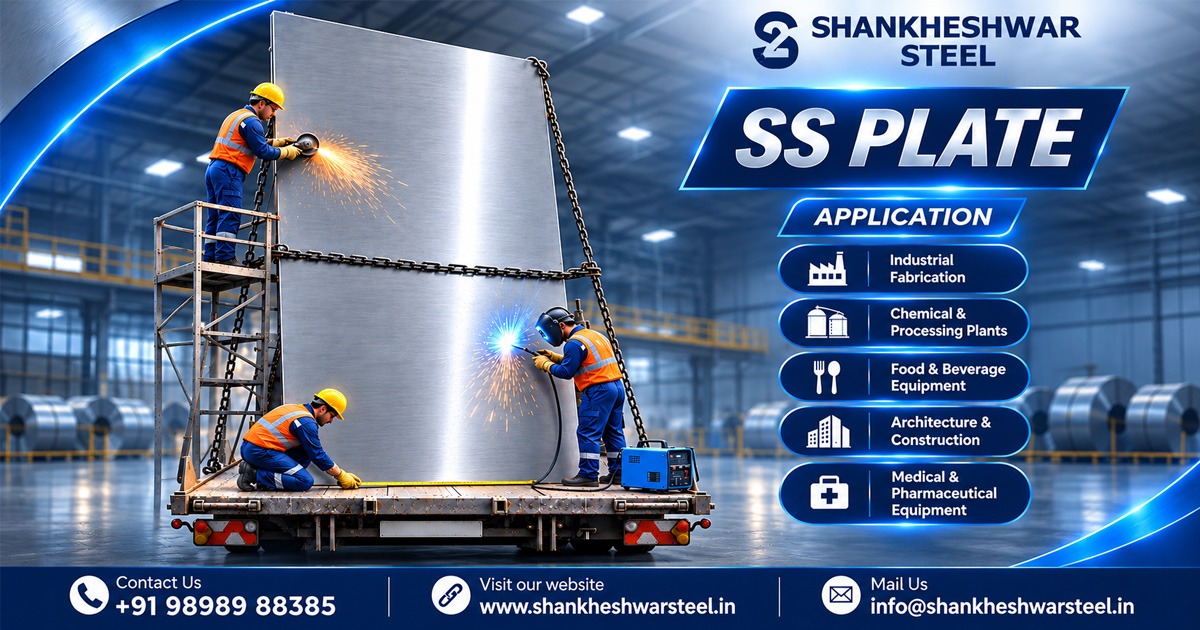
Industrial projects in Nigeria require stainless steel plates that can withstand demanding operating conditions, fabrication processes, and environmental exposure. Selecting the right grade and thickness is essential for equipment reliability. Shankheshwar Steel supports industrial material requirements from Ahmedabad, Gujarat, India.
1. How Stainless Steel Plates Become Part of Industrial Infrastructure
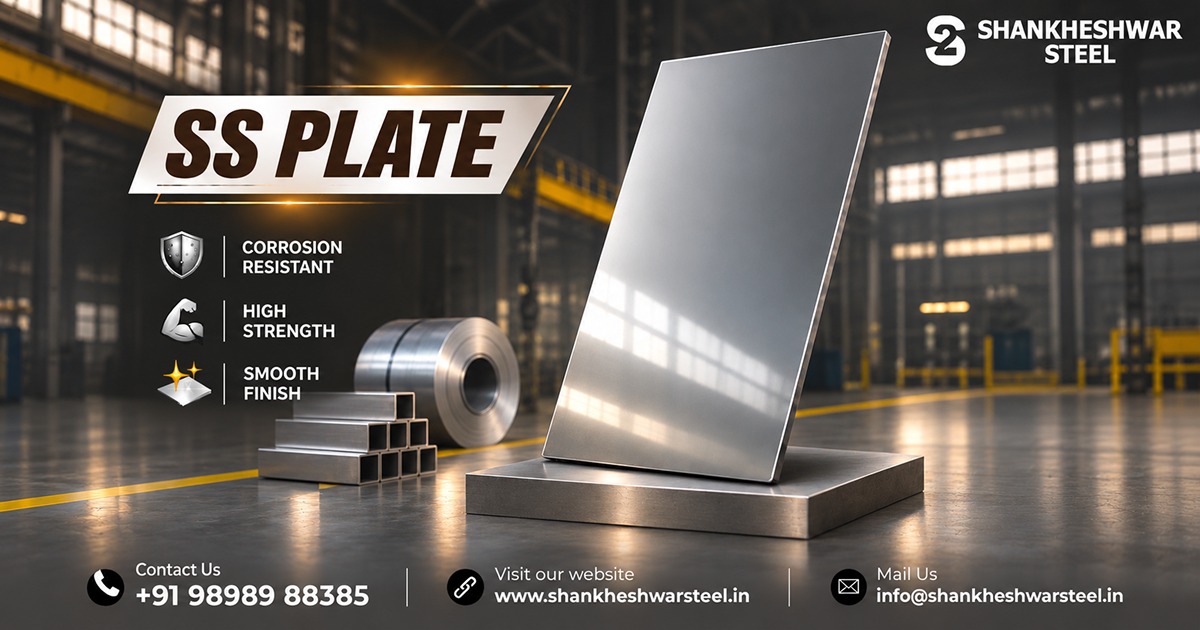
Stainless steel plates are flat metal products used to manufacture equipment, structural components, storage systems, and industrial assemblies. Their combination of mechanical strength and corrosion resistance makes them useful in industries where ordinary carbon steel may require additional protection.
For buyers sourcing Stainless Steel Plates in Nigeria for Industrial Applications, understanding the intended application is more important than selecting material based only on appearance or price.
Common industrial uses include:
- Storage tanks: Fabrication of tanks for liquids, process materials, and industrial storage.
- Chemical equipment: Construction of selected chemical handling units and processing components.
- Food processing machinery: Manufacturing of equipment where cleanable surfaces and material compatibility matter.
- Oil and gas infrastructure: Fabrication of suitable industrial components exposed to demanding operating environments.
- General engineering: Manufacturing of machine frames, platforms, covers, and fabricated assemblies.
The required plate specification changes according to the operating environment and the final equipment design.
2. Understanding Grade Differences Before Industrial Fabrication
Not all stainless steel plates offer the same material properties. Their chemical composition influences corrosion resistance, strength, formability, and suitability for different operating environments.
Some commonly specified stainless steel grades include:
| Stainless steel grade | General characteristics | Typical considerations |
| SS 304 | General-purpose corrosion resistance and formability | Food equipment and general fabrication |
| SS 304L | Lower carbon variant of 304 | Welded components and fabrication |
| SS 316 | Contains molybdenum for improved resistance in certain corrosive environments | Chemical and marine-related applications |
| SS 316L | Lower carbon variant of 316 | Welded equipment in selected corrosive environments |
| SS 310 | Suitable for elevated-temperature applications | Industrial heating equipment |
| SS 321 | Stabilized austenitic stainless steel | Certain elevated-temperature applications |
| Duplex 2205 | Higher strength with good corrosion resistance | Demanding industrial environments |
The final grade must be selected according to chemical exposure, temperature, mechanical loading, and applicable engineering requirements.
For example, an industrial tank storing a chloride-containing solution may require a different material assessment from a tank storing ordinary process water. SS 316 should not automatically be considered suitable for every chloride environment.
3. Why Plate Dimensions and Surface Condition Matter During Production
Material selection does not end with choosing a stainless steel grade. Plate dimensions and surface condition also influence fabrication quality, material consumption, and production planning.
Important specifications include:
- Thickness: Must match structural calculations, equipment drawings, and fabrication requirements.
- Width and length: Should accommodate the required component dimensions and cutting layout.
- Surface finish: Options such as 2B, BA, No. 1, and No. 4 serve different manufacturing and finishing requirements.
- Manufacturing process: Hot-rolled and cold-rolled materials have different dimensional and surface characteristics.
- Material standard: The applicable ASTM, EN, or JIS specification should be confirmed.
An important practical consideration is cutting allowance. If a fabrication company orders plates without preparing a cutting layout, it may experience unnecessary material waste or additional joints.
For larger tank and machinery projects, reviewing the fabrication drawings before ordering can help procurement teams determine suitable plate dimensions.
4. Industrial Conditions That Should Influence Material Selection
Nigeria has industrial requirements across oil and gas, construction, manufacturing, food processing, marine-related activities, and infrastructure development.
However, the same stainless steel specification may not suit every project.
Buyers should evaluate the following conditions:
Chemical exposure: Identify the chemicals, their concentrations, and the possibility of contact with cleaning agents or process fluids.
Temperature variation: Operating and cleaning temperatures can influence material performance and grade suitability.
Moisture and coastal exposure: Facilities near coastal environments may experience chloride exposure and airborne salt, requiring careful corrosion assessment.
Mechanical loading: Tanks, platforms, machinery components, and structural assemblies have different strength requirements.
Welding and fabrication: The selected material should be compatible with the planned welding, cutting, bending, and finishing processes.
A useful example is a hypothetical processing facility in Lagos. If its equipment operates near a coastal environment and handles chloride-containing liquids, the engineering team should evaluate both atmospheric and process-related corrosion before finalizing the stainless steel grade.
5. Five Checks to Complete Before Purchasing Stainless Steel Plates
Before placing an international material order, procurement teams should establish a clear technical specification.
The following checkpoints can help avoid purchasing and fabrication problems.
1. Confirm the material grade: Specify the required grade and applicable material designation instead of ordering simply by the name stainless steel.
2. Verify thickness and dimensions: Match plate thickness, width, length, and quantity with approved engineering drawings.
3. Check material documentation: Request the applicable Material Test Certificate (MTC) and verify chemical composition and mechanical properties against the purchase specification.
4. Review surface and edge conditions: Confirm the required finish, acceptable surface condition, and whether any additional cutting or processing is necessary.
5. Clarify export and delivery requirements: Discuss packaging, shipping documentation, destination port, inspection requirements, and delivery terms before confirming the order.
These checks are particularly important when importing Stainless Steel Plates in Nigeria for Industrial Applications, because material discrepancies can affect fabrication schedules and project costs.
6. Coordinating Industrial Plate Requirements With Shankheshwar Steel
Shankheshwar Steel is an Ahmedabad-based stainless steel products supplier serving industrial material requirements. Its product range includes stainless steel plates, sheets, coils, pipes, tubes, wires, rods, and industrial fittings.
With manufacturing support from Ahmedabad, Gujarat, India, the company provides a sourcing point for buyers discussing stainless steel material requirements for industrial projects.
Visit the official website: https://shankheshwarsteel.in/
Before contacting the company, international buyers can prepare the following information:
- Required stainless steel grade and material standard.
- Plate thickness, width, and length.
- Total order quantity.
- Intended industrial application.
- Required surface finish.
- Material testing and documentation requirements.
- Destination and shipping preferences.
Providing these details helps establish a clearer understanding of the material requirement and supports more effective procurement discussions.
7. Industrial Procurement Opportunities Across Nigeria
Nigeria has several commercial and industrial centres where stainless steel materials are relevant to manufacturing, engineering, infrastructure, processing, and energy-related projects.
Businesses sourcing Stainless Steel Plates in Nigeria for Industrial Applications may have requirements across the following locations:
Lagos, Ikeja, Apapa, Lekki, Epe, Ogun State, Abeokuta, Ota, Sagamu, Ibadan, Port Harcourt, Onne, Bonny, Warri, Effurun, Benin City, Asaba, Abuja, Kaduna, Kano, Enugu, Calabar, Uyo, Jos, and Aba.
Lagos and Apapa are important commercial and port-related locations, while Port Harcourt, Warri, and Onne are relevant to energy and industrial activities. Other cities support manufacturing, construction, fabrication, and regional distribution requirements.
Shankheshwar Steel provides manufacturing support from Ahmedabad, Gujarat, India. Buyers should confirm destination-specific export arrangements, shipping availability, and commercial terms directly with the company. The locations listed above do not imply that the company maintains branches or service centres in those areas.
8. Frequently Asked Questions
Q1. Which stainless steel grade is suitable for industrial plates in Nigeria?
SS 304 and SS 316 are commonly considered for different industrial applications. The appropriate grade depends on chemical exposure, temperature, moisture, mechanical loading, and project specifications.
Q2. What information should Nigerian buyers provide when requesting a quotation?
Buyers should share the required grade, thickness, dimensions, quantity, material standard, surface finish, intended application, and destination. These details help clarify the purchasing requirement.
Q3. Are stainless steel plates suitable for oil and gas equipment?
Yes, selected stainless steel grades are used in oil and gas equipment and related fabrication. However, material selection must consider pressure, temperature, fluid composition, corrosion conditions, and engineering standards.
Q4. What documents should be checked when importing stainless steel plates?
Buyers should review the applicable Material Test Certificate, grade identification, chemical composition, mechanical properties, dimensional details, and shipping documentation according to the purchase order.
Conclusion
Selecting the right stainless steel plate requires more than comparing prices and dimensions. Grade suitability, corrosion exposure, thickness, fabrication requirements, and material documentation all influence industrial performance. Shankheshwar Steel offers a sourcing point from Ahmedabad, Gujarat, India, for international buyers planning material procurement.
Contact Shankheshwar Steel to discuss your stainless steel plate requirements, technical specifications, and export-related purchasing needs for projects in Nigeria.
Website: https://shankheshwarsteel.in/
Call Us: +91 98989 88385
Email Us: info@shankheshwarsteel.in