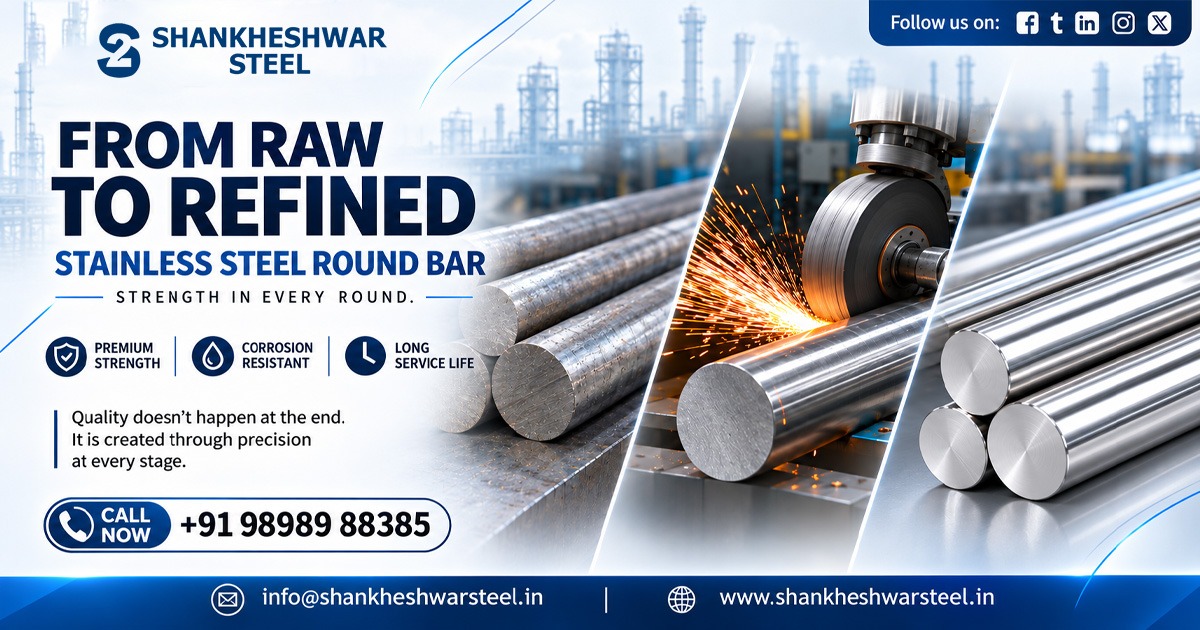
Precision engineering requires metal stock with dependable dimensions, suitable material grades, and consistent machining characteristics. Stainless Steel Round Bars for Precision Engineering Needs help manufacturers source suitable raw material for machined components, equipment parts, and industrial assemblies. Shankheshwar Steel supports manufacturing coordination from Ahmedabad, Gujarat, India.
Understanding the Role of Round Bars in Precision Manufacturing
Stainless steel round bars are solid cylindrical metal products used as raw material for manufacturing accurately machined components. They are available in different grades, diameters, lengths, and surface finishes according to engineering requirements.
In precision engineering, the quality of incoming material directly influences machining operations and the suitability of finished components.
Manufacturers use round bars when they need to produce parts with controlled dimensions, consistent geometry, and suitable mechanical or corrosion-resistant properties.
Common components manufactured from stainless steel round bars include:
- Shafts and rotating machine components
- Precision pins and connecting elements
- Fasteners, studs, and threaded components
- Valves, fittings, and equipment parts
- Bushes, spacers, and machined assemblies
Selecting an appropriate material grade is important because different industrial environments require different levels of corrosion resistance, strength, and machinability.
What Should Buyers Evaluate Before Selecting a Round Bar?
Selecting Stainless Steel Round Bars for Precision Engineering Needs involves more than checking the diameter and purchasing price. Buyers should match the material characteristics with the intended component design and machining process.
Consider these important factors before placing an order:
1. Stainless Steel Grade
Choose the grade according to operating conditions, corrosion exposure, mechanical requirements, and machining needs.
For example, SS 304 is commonly considered for general corrosion-resistant applications, while SS 316 is often evaluated for environments involving greater chemical or chloride exposure.
2. Diameter and Dimensional Tolerance
Check the required diameter, length, and dimensional tolerance against the component drawing. Incorrect dimensions can increase machining requirements and material wastage.
3. Surface Finish
Surface condition matters when round bars are used for precision machining. Buyers should identify whether bright, peeled, ground, or another specified finish is required.
4. Machinability
Consider the machining process, cutting conditions, and expected tool performance. The selected grade should be suitable for the intended turning, drilling, milling, or threading operations.
5. Operating Environment
Evaluate whether the finished component will experience moisture, chemicals, temperature variations, friction, or mechanical loading.
6. Quantity and Future Requirements
Estimate the material quantity based on production schedules, component dimensions, and expected wastage. Repeat orders should maintain consistent material specifications.
From Raw Material to Finished Component: The Processing Journey
Understanding how round bars enter the precision manufacturing process helps buyers evaluate material suitability and production requirements.
Step 1: Material Specification
The manufacturer identifies the required stainless steel grade, diameter, length, and surface condition according to engineering drawings.
Step 2: Incoming Material Inspection
The received material is checked for dimensions, surface defects, identification, and relevant material documentation.
Step 3: Cutting and Machining
The round bar is cut into required lengths and processed using suitable machines. Depending on the component design, operations may include CNC turning, drilling, milling, threading, and grinding.
Step 4: Dimensional Verification
Finished components are inspected against drawing requirements. Critical dimensions, surface condition, and other specified parameters are checked before the parts move to assembly or further processing.
This process helps engineering teams maintain better control over raw material selection and component manufacturing.
Quality Checks That Matter Before Ordering
Material quality and dimensional consistency should be verified before accepting a bulk supply. A small difference in material condition or dimensions can affect machining time, production planning, and finished component accuracy.
Buyers should check the following:
| Inspection Parameter | What to Verify |
| Material grade | Confirm the specified stainless steel grade |
| Diameter | Check against the purchase specification |
| Length | Verify required stock dimensions |
| Surface condition | Look for scratches, cracks, pits, or visible defects |
| Straightness | Check suitability for the intended machining operation |
| Material identification | Confirm grade and batch identification |
| Documentation | Review applicable test certificates and material details |
| Quantity | Match delivered material with the purchase order |
For critical engineering applications, buyers should also clarify dimensional tolerances, inspection methods, and acceptance criteria before confirming the order.
Proper material traceability is particularly important when components are manufactured for controlled industrial processes.
Matching Material Specifications With Project Requirements
Different engineering projects may require different combinations of material grade, diameter, surface finish, and supply length.
For example:
- CNC machining: Requires suitable material dimensions and machinability for accurate component production.
- Shaft manufacturing: Requires attention to straightness, diameter, and mechanical requirements.
- Chemical equipment: Requires grade selection based on the chemicals and operating environment.
- Industrial fittings: Requires suitable material characteristics and dimensional compatibility.
- Mechanical assemblies: Requires consistency between material specifications and component drawings.
Buyers should share technical drawings, grade requirements, quantity, and intended application during the enquiry process.
This makes it easier to evaluate whether the proposed material matches the actual manufacturing requirement.
SERVICES
- Round Bar Requirement Analysis: Understanding grade, diameter, length, and application requirements.
- Material Selection Coordination: Supporting buyers in identifying suitable stainless steel material specifications.
- Order and Supply Coordination: Coordinating product requirements, quantities, and delivery planning.
- Technical Documentation Coordination: Assisting with clarification of material details and applicable inspection documentation.
Industrial Supply Requirements Across Gujarat
Engineering companies, machining workshops, fabrication units, and industrial equipment manufacturers across Gujarat require suitable stainless steel raw materials for their production activities. Stainless steel round bars support component manufacturing across these industrial locations: Ahmedabad, Sanand, Changodar, Bavla, Dholka, Gandhinagar, Kalol, Mehsana, Kadi, Vadodara, Halol, Bharuch, Ankleshwar, Dahej, Surat, Hazira, Vapi, Valsad, Rajkot, Morbi, Jamnagar, Bhavnagar, Junagadh, and Kutch.
How Shankheshwar Steel Supports Industrial Material Requirements
Choosing a suitable steel supplier involves understanding product specifications, supply requirements, and the intended engineering application.
Shankheshwar Steel works with customers to understand their stainless steel material requirements and coordinate suitable product sourcing.
With manufacturing support and coordination from Ahmedabad, Gujarat, India, the company can be approached for discussions related to material grades, round bar dimensions, quantity requirements, and project-specific supply needs.
Visit the official website at https://shankheshwarsteel.in/ to learn more about the company and discuss your stainless steel requirements.
Frequently Asked Questions
Q: Which stainless steel grade is suitable for precision-machined components?
A: SS 304 and SS 316 are commonly considered depending on corrosion exposure and application requirements. The final grade should be selected according to the component’s operating environment and engineering specifications.
Q: How do I select the correct round bar diameter?
A: Check the component drawing, finished dimensions, machining allowance, and available material sizes. The selected diameter should provide sufficient stock for the planned machining operations.
Q: Which surface finish is suitable for precision engineering?
A: Bright, peeled, or ground finishes may be considered depending on dimensional tolerance and machining requirements. The appropriate finish should be confirmed before ordering.
Q: What documents should I request when purchasing stainless steel round bars?
A: Request applicable material test certificates, grade identification, dimensional details, and batch traceability information. Documentation requirements may vary according to the application and purchase specification.
Conclusion
Choosing the right stainless steel raw material is important for dimensional accuracy, machining efficiency, and component reliability. Stainless Steel Round Bars for Precision Engineering Needs should be evaluated through grade, diameter, finish, and inspection requirements. Shankheshwar Steel supports material coordination from Ahmedabad, Gujarat, India, for industrial buyers.
Contact Shankheshwar Steel
Looking for stainless steel round bars for your engineering or machining requirements? Contact Shankheshwar Steel to discuss material grades, dimensions, quantities, and product sourcing requirements.
Website: shankheshwarsteel.in
Call Us: +91 98989 88385
Email Us: info@shankheshwarsteel.in
For more information, please feel free to contact us.